Monday, April 24, 2006

Fitting Maserati 3200 GT turbos to a Ghibli

Last year I decided to replace the turbos on my Ghibli with those from a Maserati 3200 GT. There were a couple of reasons why I wanted to do this: I wish to slowly upgrade and tune the car, which undoubtedly means increasing the flowrate through the engine; I wanted to reduce the lag time of the turbos; I wanted some more reliable turbos.

The early Ghibli IIs (like mine) came without blow off valves (see earlier post) and as a result, there's a good chance that the turbos on these cars will fail sooner than those fitted on the later cars, due to the constant spooling and stalling that results from not having blow off valves. However, my Ghibli had only done low mileage (around 55,000 km at that time) so the turbos were still in good shape. So it was really a bit premature to change them out... but the opportunity arose.


The turbos on the 3200 GT are technically more advanced than the ones fitted on the Ghiblis, since they incorporate a roller bearing package over the plain bearing package on the Ghibli turbos. The turbos for both cars were manufactured by IHI of Japan. The power side of the turbo on the Ghibli and the 3200 GT is the same except for the bearing package, denoted by the suffix letter in the product description, RHB for the Ghibli and RHF for the 3200 GT. The compressor side is larger on the 3200 GT turbos, which is not suprsing given that it's a 3.2l engine versus the Ghibli's 2.0l. However, I'm eventually planning on further increasing the maximum RPM, polishing up the heads and fitting a free-er flowing exhaust, so the additional capacity that the 3200 GT turbos cater for will eventually be utilised in my Ghibli.

The cost of the increased capacity of the 3200 GT turbos is increased lag time. However, this is offset by the bearing package on these turbos versus the Ghibli turbos; the lower friction co-efficient of the 3200 GT turbos means less resistance to rotation, which means that like for like they should speed up quicker than the Ghibli units. So, factoring in the fact that the compressor is larger on the 3200 GT turbos and therefore doing more work, the net effect is that the 3200 GT turbos spool up at about the same rate as the Ghibli turbos.

I was fortunate to acquire some nearly new 3200 GT turbos from David Askew Maserati Parts Service, with only 14,000 miles on the clock. I had them shipped directly to the Maserati specialist Auto Forza, where Jorrit promptly fitted the units for me, taking about 2 days since there was a bit more messing around than he had anticipated. The exhaust manifold on the 3200 GT and the Ghibli is obviously different, so the old manifold from the Ghibli had to be retained and re-used. This meant that they had to be carefully removed from the engine block and the old turbos, which is easier said than done given that the bolts seize up pretty tight here given the heat they're subjected to.

The new turbos were a very snug fit and the engine had to be lifted slightly at the front of the car to accommodate them. This was done by inserting some washers underneath the engine supports between the engine and body, lifting it about about 10 mm. Some material also had to be shaved off one of the new turbo housings (the right one I think) to prevent it from touching the body, particularly when turning.

Once fitted, it was a bit tricky to determine what effect the new turbos had had on performance. When I initially took the car for a dyno, it was giving around 310 hp but only producing 0.7 bar boost pressure. No one could figure out why the boost pressure was low, although 0.7 bar just happened to be the fail safe pressure for the OEM boost controller. There was no engine warning light and the chip tuners confirmed that the fuel map was being followed. We could only think that the car was running in safe mode, but no one, including Jorrit, could figure out why? It didn't seem to be the solenoid, particularly since this had been recently changed out after a similar previous incident when the car was found to be running again at 0.7 bar due to the solenoid not working.

Since we couldn't find a mechanical problem and the chip tuners at Rica Engineering swore that it wasn't a problem with their software, I decided to purchase a new boost controller, an e-Boost 2 from Turbosmart in Australia. I fitted the boost controller and completely removed the OEM solenoid (seems there's no feedback loop from the solenoid to the engine ECU since the car runs fine with the solenoid not connected). I took the car back to Rica and set up the e-Boost on the dyno. However, despite the car now producing about 1.2 bar of inlet pressure, the power output was down at about 270 hp!

It took a lot of thinking and running of a few tests (including a cyclinder leak test, which showed that the engine was in pretty good condition, with only 5% leak from most of the cyclinders, but oddly with 20% leak from the cylinder on the rear right). I was convinced that it was the exhaust that was the problem, so asked Jorrit to try swapping out the mid section with a known good unit (which he fortunately had in his workshop). He took the car for a drive and instantly noticed a difference! So it was definitely exhaust related.

When putting back the old exhaust, he happened to notice that one of the pins on the lambda sensor was bent and not connecting properly. He straightened the pin and connected it back. When driving the car with old exhaust re-installed, it was driving much better than previously, although I suspect that not as good as with the replacement exhaust. So the problem appeared to be with the lambda sensor, which means that the engine had probably been running in open loop mode, unable to correctly measure and interpret the exhaust gasses. This means that the car had probably been running rich, which would explain the drop in power. It also means that the catalysts have become junked, since running a rich mixture through a catalyst will end up seizing it up. I find it a bit odd though that the engine warning light did not come on when this was occurring? So I'm tempted to install a data acquisition system so that I can monitor the mixture myself and not rely on the ECU's electronics doing the right thing.

This would explain the results from the next visit to the dyno at Rica. Although the results were better, now putting out 328 hp, it was not as good as I had anticipated. I'd figured that the car should deliver about 360 hp given that I had been getting 327 hp before the turbo upgrade (since the car had been chip tuned previously and was now red-lining at 7200 rpm). I also set up the e-Boost again while on the dyno and noticed that the turbos were by no means hitting their limits; I was not able to get the sensitivity of the controller to overshoot the dialed in maximum boost pressure of just over 1.2 bar. This means that there's probably insufficient exhaust gas flowing through the turbos (i.e. that the turbos are too large for the current application).

I find this a little bit hard to swallow. Given the evidence, I'm convinced that there's a restriction across the catalysts that's robbing some power from the engine. Also, the restriction may cause sufficient pressure drop in the exhaust to restrict the gas flow from the engine, which would result in the turbos not spooling up so quickly.

Of course, there's only one way to tell and that's to try fitting a new exhaust and take the car on the dyno... I'm planning on doing this later in the year...

Tuesday, April 18, 2006

Korst Banden

I paid a visit to Korst Banden last week. I wanted them to have a look at the Ghibli so that they could measure up the wheels and give me some confidence about ordering the correct size wheels. To be honest, I was a little disappointed with the service there.

They didn't seem too interested in measuring up the wheels and I felt like I was telling them what to do rather than them offering me advice. I've a feeling that they're not really into customising wheels, rather offering direct replacement wheels and tyres. One of the younger guys in the workshop did come and have a look and seemed pretty confident about what I was proposing, but the older guy who was at the front desk seemed more interested in ordering the wheels and seeing if they fitted... which is fine if they're prepared to take the wheels back if they don't fit.

They did at least seem OK about trying out some different tyres once the wheels were fitted. He seemed a bit concerned about the tire selection for the front wheels; he thought there might be too much rubber on a 225/40 R18 tyre and thought that a 225/35 R18 tire may be more suitable.

I'm going to order the wheels with the same offset as the current wheels and they see how they fit; hopefully it will all work out and if the fit is too tight I may have to go with 215/35 R18 on the front and 245/30 R18 on the back, or get the lip rolled up. I'm a bit reluctant to go with the latter, since it will be a bit expensive gettting this done, since it will likely involve a paint job.

Guess I'll just have to wait and see...

Friday, April 07, 2006

PC wheels out of the running

After further emails with Korst Banden, the local retailer of Compomotive wheels in the Netherlands, it looks like the 3 piece PC wheels are out of the running since they're about twice the price of the MO wheels.

I sort of set myself a limit for how much I'm prepared to spend on wheels for the Ghibli and that's about 10% of the value of the car. Unfortunately, the PC wheels are just too expensive given the value of the car, although I do still think they are nicer looking wheels.

After some more emailing with Compomotive in the UK, I've received some better pictures of the wheels that I'll probably be ordering, with a center hub blank for an offset between ET30 and ET40.

This first one is of the proposed front wheel, 18" x 8" with standard silver finish. I'd prefer the spokes not to come flush to the face of the rim, but it doesn't look too bad. I'm also not too keen on having the Compomotive logo stamped on one of the spokes, but again I can live with it, bearing in mind the whole reason I'm after new wheels is not for cosmetic reasons, but to give me some more ground clearance without adversely effecting the handling characteristics of the car.

This second picture shows the 18" x 9" wheel that would be fitted to the rear of the car, this time with optional sparkle silver finish. I like the way the spokes sit further back in this wheel, giving it a bit more or a sporty appearance. The wheel shown has four studs, which I find a bit odd for this size of wheel?

Overall, I think they'll look OK on the Ghibli and after doing some more sums, I'm confident that they'll solve my ground clearance problems. I anticipate well over 20mm additional clearance at the front of the car, which should prevent the anti-roll bar infront of the engine sump from fouling with steep speed bumps.

Just behind the front wheels where the catalysts are located in the center of the car, there should still be about 20mm additional ground clearance with the new wheels. Maybe this doesn't sound like much, but I'm pretty confident that this will prevent about 90% of the fouling I currently get when going over speed bumps. If this turns out to be the case then I might even replace the catalysts with some new ones (since I'm an environmentalist at heart).

Thursday, April 06, 2006

Further developments on the wheel front

I spoke with Jorrit yesterday and got some further insights into the Maserati Ghibli!

It seems that on the MY92 cars, Maserati left the lip on the inside edge of the wheel arches unfinished, so these stick out into the wheel arch at a 90 degree angle to the body panel and impair on clearance of the wheel. On the MY94 cars, presumably as a result of factory fitting larger wheels, this lip was rolled out on the top half of the wheel arch, increasing clearance between the body panel and the wheel.

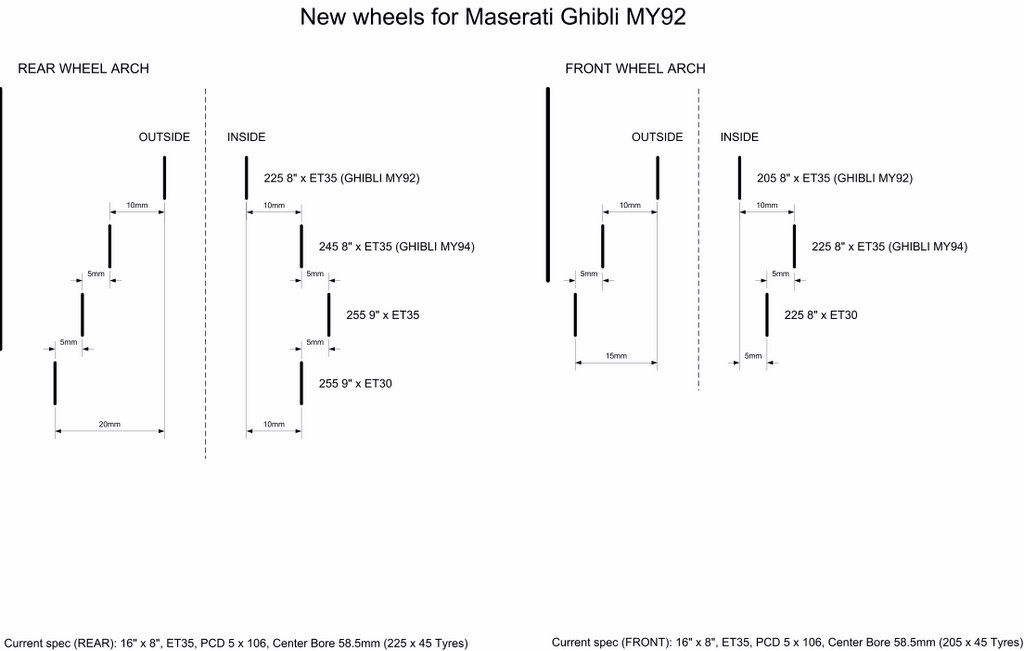
As a result, on my MY92 Ghibli, I'm a bit more restricted on the offset that I can fit before I start getting interference between the wheel and the body panel. This means that the minimum offset on the MY92 cars is restricted by about 10-15mm from the MY94 cars, unless the lip is rolled up. Since this modification will necessitate a trip to the body shop (to get the metal resprayed after rolling it up) then I have decided limit the reduction in offset.

I also discovered that on the MY92 cars, the offset of the factory wheels (the seven spoke OZ Racing wheels) is ET35 on the front and ET32 on the back and not ET35 all around as I originally thought.

I enquired with Compomotive the prices of the MO and PC wheels, but they referred me to a local retailer, so I'm planning on making a visit to get the wheels properly measure up to ascertain the optimum offset specifications. They did however send me a nice picture of some 18" MO wheels fitted to a Ferrari.


These are 9" wide on the front and 10" wide on the back. I find them a bit delicate, which suits the Ferari, but not sure it fits the more agressive styling of the Ghibli. So I'll probably go with the PC wheels still.

For info, the Dutch retailer for the Compomotive wheels is Korst Banden BV.

Wednesday, April 05, 2006

Development on the wheel front

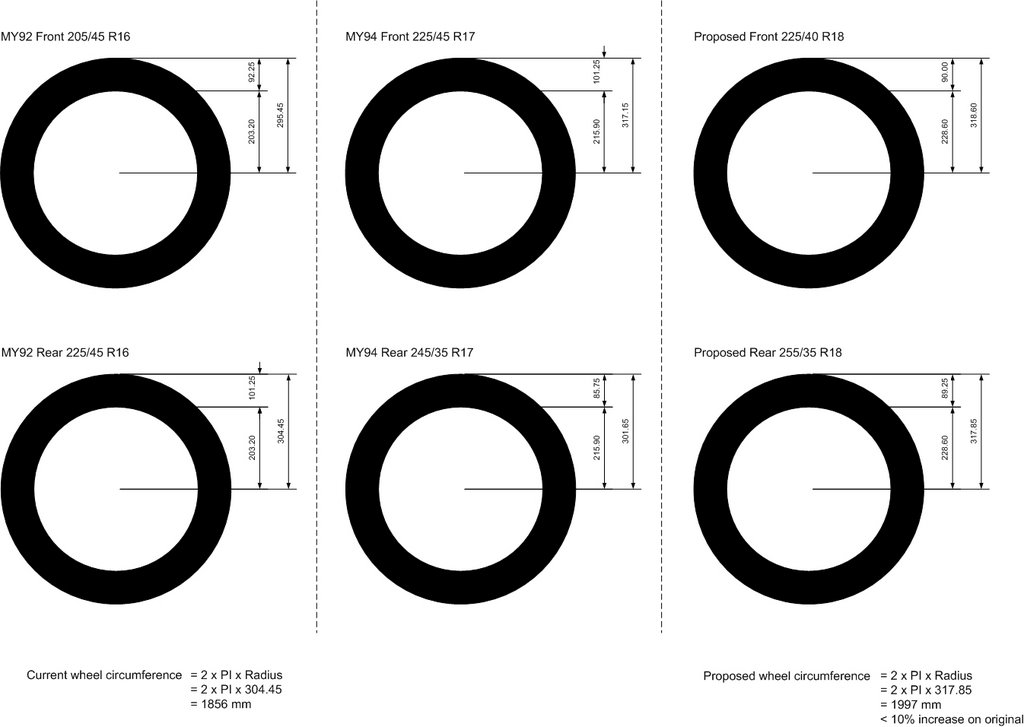
I've been doing some more thinking on the wheels. In addition to the space out described below, I've been thinking some more on wheel diamter and tyre selection and come up with the following schematic.


I've also been having a rethink on wheel selection, still from Compomotive in the UK, but a three piece modular wheel design, as pictured. I like this wheel because the spokes are set in from the front of the wheel, giving it a more sporty, agressive look. I also think they fit the style of the Ghibli, with a nice simple five spoke design. I'd prefer not to have the studded rim (and a bit worried that it will leak), but this does have its advantages with respect to maintenance if the rims get curb damage.

I think I'll go with an offset of ET30. I could probably get away with less on the rear, but I'd like to have the same wheels on the front and back so that I can swap them round if the fronts get some minor damage.

The increased overall wheel diameter at the front should give quite some additional road clearance; about 20mm on the radius to lift the car to about the same as an MY94 model. The tyre selection will still give me about the same amount of rubber around the wheel as I have currently, so resistance to curb damage to the rim should be the same as I have now.

On the rear, the increase in diameter will give an increase in the wheel circumference and hence a bit of additional gearing. However, this is less than 10% and I know that the speedo on my Ghibli currently overestimates speed by about 10% (I measured it late last year when driving back from Germany; the speedo was reading about 265 km/h but my TomTom was reading about 250 km/h). So it's still legal.

For tyres, I see that Bridgestone offers the sizes that I'm after in their Potenza S-03 range (Bridgestone Tyre Size Line-Up), i.e. 225/40R18 on the front and 255/35R18 on the rear (and suitable for speeds over 300 km/h!).

I'm just running the numbers past Jorrit at Auto Forza to check if the clearances will be OK. If he thinks it's all OK then I'll be placing my order soon!

Tuesday, April 04, 2006

Ghibli survives another winter

I took the Ghibli out on the road this weekend, after it's been wrapped up over the winter months. I reconnected the battery (after disconnecting it over winter) and it started up no problems straight away!

I drove it nice and carefully with low revs until the engine was warmed up. The only thing I noticed was that a lot of steam was coming out of the exhausts (when I stopped off at the local Shell petrol station to squirt in some Pura and a spot of injector cleaning fluid). This seems pretty typical of the car, particularly on cold, damp days.

I drove the car to Rotterdam and had a nice breakfast with the missus at Proef! On the way back I opened the car up a bit, mainly just to intimidate an Italian plated Lancia driver who was being very aggressive to the cars in front, flashing his lights and indicating that he wanted to overtake, so I thought I'd embarrass him a bit by leaving him standing. Anyway, the car performed great and I had to feather the throttle a little to prevent the rear tyres slipping on the damp road surface.

The Ghibli is now rapped up in it's new home; I purchased a garage space just down the road from our new house and now have the car parked next to it's new friend, an Audi A3.

Tuesday, March 21, 2006

APK action items for Jonny's Ghibli

Here's a list of things that need to be checked/fixed when my Ghibli next gets serviced:

  1. Windscreen washer nozzles; the driver's side nozzle needs adjusting to point in the right direction, since it currently leaves a big patch of unwashed glass which impedes the driver's view of the road.
  2. The fuel pump is making a whizzing noise; it probably needs cleaning or replacing.
  3. The courtesy light in the boot isn't working; probably a faulty connection somewhere in the boot.
  4. It's almost time for the big 60,000km service, so the timing chains will need replacing.
  5. I'm going to order a new front exhaust section from Larini; I'm positive that the catalysts currently installed have become restrictive after the car ran for a while too rich (due to a dodgy connection on the Lambda probe I think the car was running in open loop for a couple of months, although it's strange that a warning lamp never came on in the dashboard?).
  6. I may ask Jorrit at Auto Forza if he can set up the buttons on the center console to illuminate when the driving lights are switched on.
  7. The radio isn't working; I suspect that either the antenna has stopped working or that there's a bad connection/broken wire between the radio and the antenna.
  8. Since the car will now be garaged and off the street, I may get the damaged bumpers changed out. There's also a dent in the underbody after a mishap with an hydraulic jack that I'd like straightening out.
  9. The belt driving the alternator is slipping slightly and needs tensioning.
  10. Sounds like there's something loose in the airco ducting, maybe a leaf? It stops when the fan is switched off.
  11. The volt meter still only works periodically. I can live with this, but I'd so much like it fixing!
  12. The tracking is slightly off; seems to get knocked off centre pretty easily.
  13. The clutch pedal is squeaking; I think it's the spring that needs oiling a bit.
  14. The handbrake needs tightening. Again. The Ghibli's handbrake seems to be a bit problematic.

Once the exhaust is changed out, I'll take the car back to Rica Engineering to get the fuel remapped; it's currently running a bit rich, which is loosing a few hoursepower I suspect.

Other than that, the car seems to be running pretty well, although I've not been out in it for a few months... waiting for the salt to get washed off the roads!

Friday, March 03, 2006

Wheels for Maserati Ghibli MY92

I've been looking for new wheels for my Ghibli for ages now. Don't get me wrong, it's not that I dislike the OEM wheels (I've got the OZ racing 7 spoke 16" wheels, see previous postings for pictures), it's just that there's so little ground clearance on ym Ghibli.

Having said that, I do think the Ghibli looks good with larger diameter wheels and the decrease in the effective offset from the wider later wheels fills up the wheel arches much nicer. But my biggest problem with the Ghibli is getting over speed bumps and living in the Netherlands this is a common problem. It really breaks my heart everytime I hear the catalysts scraping on the ground; this car was obviously not designed with catalysts in mind and they must have been fitted as an after thought, driven by regulation.

It's not just the catalysts though. Not only are there lots of speed bumps in the Netherlands, but lots of brick roads. Couple this with subsidence and there's lots of potential for catching the anti-roll bar and engine sump on the uneven brick road services. So my driver for fitting larger wheels (other than for aesthetics) is to increase ground clearance (although there is another way, by inserting some spacers in the strut towers... ask Enrico for details).

But here's where the problems start. Maserati use really weird wheel fitting specifications, particularly on the early Ghiblis. Mine has a PCD of 5x106mm. I've not seen any other car with this PCD. I'm informed that the center bore is 58.5mm and the offset is ET35. I've looked long and hard for off the shelf wheels with these specifications, but to no avail. The only real option for a perfect fitting wheel is to get them made.

Here's a schematic I've put together of what I think the OEM wheel specifications are versus what I think I'd like. I'm not 100% confident with the proposed offset, but I've not got around to measuring it up properly yet.


One place that does sell customised wheels off the shelf (they appear to make blanks, which they drill out the the PCD and center bore to order and fit hub spacers to attain the correct offset) is Compomotive wheels in the UK. This company supplies wheels to the motorsport industry, noteably for rallycross.

Their MO wheel comes in 18" diameter and both 8" and 9" widths, which would be perfect for the front and rear wheels repectively on the Ghibli. It's probably not a wheel I would choose normally, but given that there's not much alternative (other than having a custom wheel manufactured and paying the price!) I could live with the design; it looks a bit retro and fits the 80s styling of the Ghibli. If you're interested in these wheels, try contacting Mark at Compomotive wheels.

Another alternative is to acquire a wheel with a PCD of 5x108mm and use some wobbly bolts to attach the wheel to the Ghibli's hub. This PCD is more common, particularly with wheels for Volvos. However, the offset of these wheels tends to be a little bit too much and a wheel spacer will be required to get the wheel nice and flush with the Ghibli's body. However, when using wobbly bolts, it's not recommended to have a wheel spacer thicker than 5mm, unless it's hub-centric. Try getting a hub-centric wheel spacer with these specifications. If you go this route, then try talking to William at Performance Alloys in the UK.

I'm still in two minds as to whether or not to purchase these wheels, since I'm also toying around with getting a new exhaust, which should help remedy the ground clearance problem with the catalysts and give me some more power to boot.

I'll keep you posted.

Wednesday, March 01, 2006

Blow off valves (BOV) for Ghibli

 
About a year ago I installed a pair of blow off valves on the Ghibli. I have an MY92 Ghibli with a 2.0l bi-turbo engine that did not come with recirculating type blow off valves that were fitted to the later MY94 cars. Therefore, every time I changed gear, the turbos would stall as the pressure on the inlet side of the engine backed down to the compressors.

This effectively increased the spool up time when accellerating after each gear change, making the car feel momentarily sluggish. But worse than this, it was putting unnecessary wear and tear on the turbos as they were constantly being accellerated and decellerated, which effectively decreased the longevity of the turbos.

To remedy this problem, I got help from the guys at Forge motorsport in the UK. After measuring the dimensions of the aluminium intake pipes prior to the throttle body, I asked the guys at Forge if they could weld the blow off valves directly onto some new pipe sections. These were then direct replacements for the existing pipes.

The location of these valves is pretty good, since they're located close to the throttle body, which means that they bleed off pressure pretty quickly without the entire inlet system pressuring up. The control line for the two blow off valves is teed together before connecting to the back of the plenum chamber; Jorrit at Auto Forza drilled a hole, tapped it and installed a push fit connector on the back of the plenum chamber for me. The control lines are blue in the picture above, but I've since replaced them with black hoses and fed them beneath the plenum chamber so that they now look like they were fitted by Maserati.

In action, the valves work very well. The car feels more lively when driving hard and feels like it's more poised and ready to go when accelerating hard through the gears. And of course, it makes a great sound as the valves vent off into the engine bay with each gear change. It's not too loud though; since I have two valves fitted, the air is not rushing out with as much vigour as it would with just a single valve. It's still loud enough to scare a few people walking in the street though.

I'd definitely recommend anyone with a pre MY94 Ghibli with no factory fitted blow out valves fitting these valves. Posted by Picasa

Sunday, January 29, 2006

Bespoke Maserati Ghibli car cover


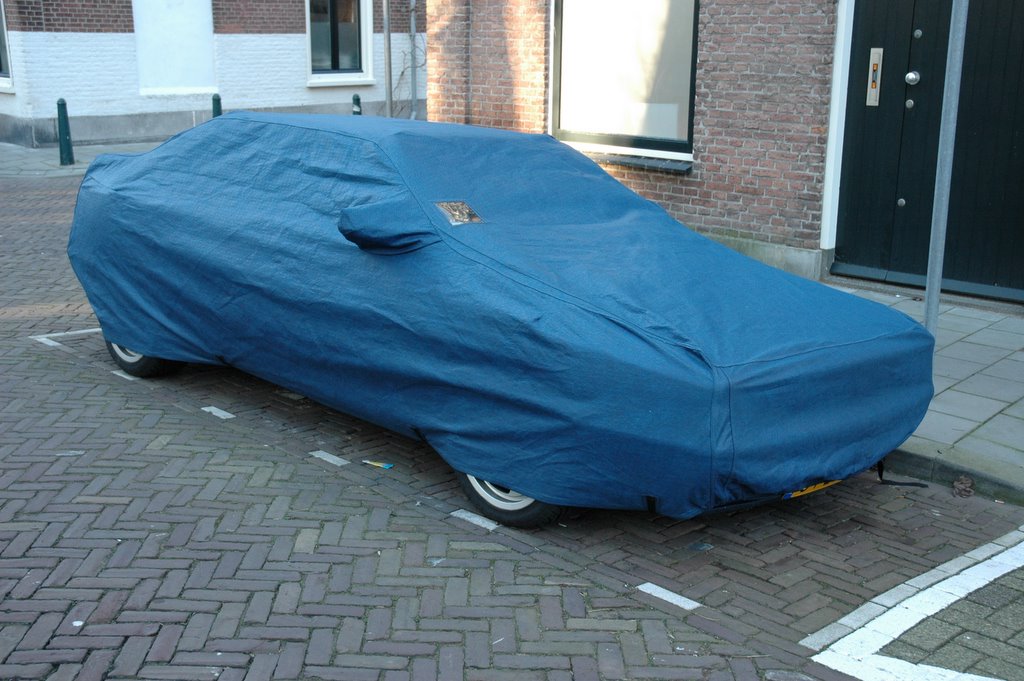
Until recently, I did not have a covered parking space for my Ghibli, which meant parking the car out in the street. To protect the car from the elements, I purchased a taylor made car cover soon after purchasing the car and I think this has been one of the best investments I've made for the car!

I was not confident that I would find a car cover to fit the Ghibli, since it's a rare car and not many companies make products for it. So I was pleasantly suprised to discover a quality car cover supplier in the UK that could deliver me one within a couple of weeks, since they already had a pattern for the Ghibli!


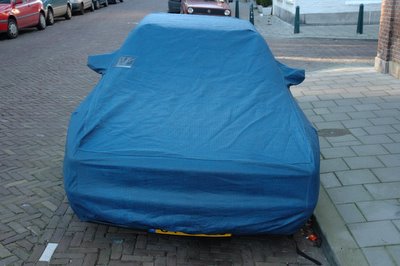
As you can see from the pictures, the cover fits very well and I've been very impressed with it's performance. I got the outdoor version and regardless of how wet it is outside, the car remains dry. Even when I've been caught out by the rain and the car has got wet, I can still stick the cover on it and take it off when it's dry outside and find the car dry; the 3 layered material breathes, so it lets moisture out but not back in.

The customer service has also been excellent from the supplier. I woke up one morning and found that a careless cyclist (there's a lot of them around here) had ripped the cover while cycling past the car; they clearly hit the car with some force since they also left a scratch in the paint. Anyway, I contacted the supplier and asked for a piece of material so that I could patch up the tear. They sent it straight away free of charge. Also, once I forgot to fasten the straps with the supplied nylon fittings and they subsequently got run over and badly damaged by cars driving past in the street. Again, I contacted the supplier to ask if they could send me some new ones; they did so immediately and again free of charge!

I've had the cover for about 2 1/2 years now and have been very happy with it. Even when I've had the car in storage in a garage over winter, I still left it with the cover on to act as a dust cover. It's seen some pretty hard wear and pretty severe weather, but it's still going strong.

The supplier is Specialised Car Covers of the UK; try doing a Google search in the search bar on the right.

Friday, January 27, 2006

Modifying a Ghibli for tall people

The Maserati Ghibli was obviously designed during a time when people were shorter. Either that, or Italians are a nation of vertically challenged inhabitants. Admittedly, I'm distinctly above average height at 1.99 m (which is perhaps why I've found myself at home in the Netherlands?), but I think it's generally accepted that the seating position is a little awkward in the Ghibli for drivers of above average height.

To compensate for this, two solutions were implemented in my car. The first is mentioned in my post below, where a custom made steering column spacer hub was installed. After locating a design drawing for a similar item for a Porsche 911 on the web, the Maserati specialist from whom I purchased the car promptly turned the drawing into the real thing. Coming from a background of car restoration, he has a number of useful contacts, one of which was able to machine the spacer. As a nice finishing touch, the spacer was then powder coated in matt black and once fitted it looks like an OEM part. And the nicest thing was... it was free of charge; it was negotiated into the price of the car.

Subsequently, I learnt of a similar item on Enrico's Maserati Pages in the "Can you help...?" section, so if you're after something similar then try Googling this site (or try this link and scroll down the page to the bit about Nardi).

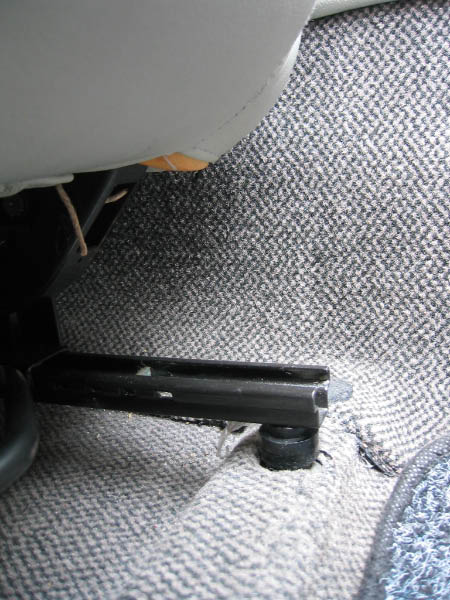
The picture on the left here is of a seat rail (this one is one of the front passenger seat rails) which attach the seat to the floor of the car and enable it to slide forward and backward to suite the occupant.

Next was a trick I'd seen in an old Mini that a tall friend of mine used to have when I was at school. To increase the leg room (and make pressing in the heavy clutch on the Ghibli a little less fatiguing) a pair of seat rail extensions were made, again by the very helpful Maserati specialist from whom I purchased the car.

As you can see from the picture on the left, the original seat rails have a 10-15 mm spacer between the seat and the floor. This may not sound like much, but may be enough to prevent a tall driver from getting a stiff neck on a long drive by not having to crouch down in the driver's seat!

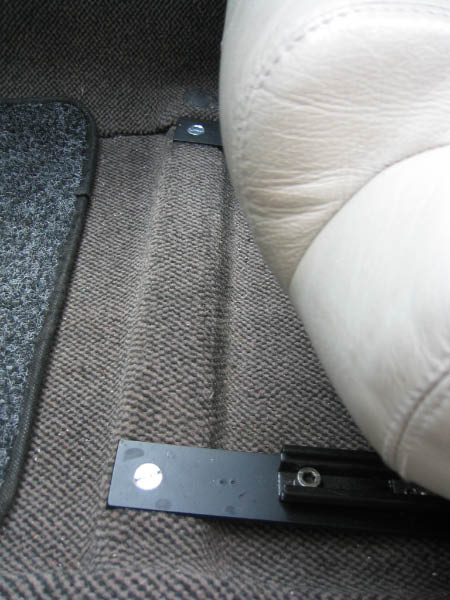
So, the seat was temporarily removed from the car, the spacer removed and a strip (30 mm width approximately) of decent guage, powder coated steel bolted to the floor in place of the original rails. This strip has pre-drilled holes in it, appropriately positioned to enable the seat rails to be bolted onto it, as illustrated in the picture on the right. The seat rails are now located about 60-70 mm further back than original, and about 20 mm lower. This, coupled with the steering column extension has made the driving position far better than original (for me) and enabled me to drive considerable distances in comfort (such as from the Netherlands to Switzerland, although admittedly the wife helped out!).

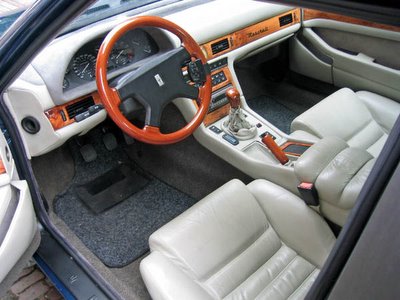
The only negative aspects of these modifications are that the steering column controls (the stalks for the lights and wind screen wipers) require fully extended fingers to reach them with hands on the steering wheel and there is no (absolutely non) room behind the drivers seat when I'm driving the car, as illustrated in the picture below. However, it's arguable that there's enough space in the back for adults regardless and in my mind, the advantages of the modification far outweight the minor disadvantages. And, unlike my school friends Mini, I have plenty of room to engage 3rd (5th on the Ghibli) gear without being obstructed by my knees!

Thursday, January 26, 2006

Background of Jonny's Maserati

I purchased my Maserati Ghibli in the summer of 2003. I was actually after a Ghibli Cup or a Ghibli GT, but was so impressed with the condition of this car when I saw it that I was convinced to change my mind and go for this. It was built in 1992 and registered in Italy in 1993, so was one of the first Ghiblis produced. It had a single owner in Pisa, Italy until 2003, when it was imported and registered in the Netherlands by the Maserati specialist from whom I purchased the car (from Jorrit (who I thoroughly recommend), formerly at the Roy Karsten workshop in Noordwijk, but now with his own workshop called Auto Forza in Noordwijkerhout). Despite being 10 years old when imported, the car had only 45,000 km on the clock and had obviously been well looked after; it still had (and still has) remnants of the protective plastic coating on the leather interior!

The car was built for the home Italian market; it has a 2.0 liter version of the bi-turbo engine, producing 306hp from the factory. The engine is coupled to the 6-speed Getrag manual gearbox. Since this is an early model Ghibli, the engine is fitted with a conventional distributor and has the original 7 spoke OZ racing 16" x 8" wheels, with 205x45 tires on the front and 225x45 on the back.

The interior is beige leather with the usual walnut trim. A steering column boss was custom made (by an associate of Jorrit at Auto Forza) and fitted behind the steering wheel in order to bring the steering wheel out a couple of inches; the car was obviously designed with Italians in mind!

Jonny's got a brand new blog

Sorry to start off this post with a picture of me... I'm not being a narcissist, it's just this is the easiest way to publish a picture on the web and be able to point at a URL in my blog profile.

I'll spend the next few weeks documenting some of the work and events that the car has experienced since I've owned it and of course give a bit of background to the car. I'll then use the blog to keep a running commentary of living with the car. I might even give an indication of running costs? I'm not sure yet, since I may not want the missus to see that! :-)

I'm also very aware of how difficult it is to find information on these cars, let alone suppliers for parts and add-ons. I'll therefore start listing where I've got bits from and who's done work on the car.

Anyay, I hope you enjoy the blog and maybe by sharing my experiences I may help out a few other Maserati Ghibli drivers? If you are looking for help with a Maserati or just want to know some more about the manufacturer, I can thoroughly recommend Enrico's Maserati Pages.

Good luck!